

You step outside on a bitterly cold January morning and a sound like a gunshot rings through your yard. No one fired a weapon. What you just heard was one of Ontario’s most startling winter events, exploding trees. This phenomenon affects thousands of trees across Middlesex County every winter when Arctic air drives temperatures far below freezing. Stumps ‘R’ Us provides professional tree care in St. Thomas and the surrounding London area, and our arborist breaks down what happens, which trees are at risk, and when you should call for help.
What Causes Trees to “Explode” in Winter
Trees do not actually blow apart. The real cause is a frost crack, which is a vertical split that forms when temperatures drop rapidly below -20°C. Here is what happens inside the trunk during a sudden deep freeze.
Tree sap is mostly water mixed with dissolved sugars. When that sap freezes, it expands the same way a pipe bursts in an unheated basement. This expansion pushes outward against the wood with enormous force. At the same time, the tree bark on the outside shrinks as it cools faster than the inner wood. Just beneath that outer layer sits the cambium layer, a thin ring of living tissue that produces new growth each year. This sensitive layer takes the full force of expanding ice pushing against contracting bark. When the pressure becomes too great, the trunk cracks open with a sharp bang. People often call this a tree explosion because the sound carries across an entire neighbourhood.
This ice cracking inside the trunk is dramatic, but the tree usually stays standing. The split relieves the built-up pressure, and the trunk remains structurally connected above and below the crack.
The Science Behind Frost Cracks
The National Forest Foundation has documented this phenomenon across centuries of cold-climate winters. Sap freezes well below 0°C due to its sugar content, so a tree explosion typically requires a rapid plunge during a polar vortex event rather than a slow, steady chill.
Vertical splits can run several feet along a trunk, exposing inner wood to moisture, insects, and disease. The ice cracking pattern follows the grain of the wood, which is why these cracks appear as long, straight lines rather than jagged breaks. This effect has been recorded across Ontario, the Prairie Provinces, and the northern United States.
Ontario homeowners should also understand the difference between frost cracks and frost quakes. Frost quakes also called cryoseisms happen when frozen ground expands and cracks with a deep boom that can rattle windows. Both events occur during extreme cold, but they affect different parts of your property.
Which Ontario Trees Face the Highest Risk
Frost cracks target deciduous hardwoods far more often than evergreens. Trees with thinner tree bark lose their protective insulation once their leaves drop in fall. Trunks that face south or southwest get the most direct winter sun, which warms the bark during the day before temperatures crash at night. This repeated heating and cooling cycle weakens the wood over time.
Common Ontario trees affected by frost cracks include:
- Maple trees (Norway maple, sugar maple, silver maple)
- Ash trees (especially those already weakened by emerald ash borer)
- Oak trees and elm trees
- Birch trees and poplar trees
- Fruit trees (apple, cherry, peach, pear)
Evergreens tell a different story. White Pine trees, spruce, and cedar keep their needles year-round, which insulates the tree bark and buffers temperature swings. Even pine trees in warmer southern climates never develop frost cracks, which confirms this problem belongs to cold-climate hardwoods with exposed, bare trunks.
Are Exploding Trees Dangerous to People
The name sounds frightening, but exploding trees do not launch shards of wood into the air. The ice cracking releases pressure through a single vertical split, and the tree stays intact. The Wisconsin Department of Natural Resources confirms that frost cracks alone rarely kill a healthy tree.
That said, a frost crack can signal deeper trouble. A cracked tree near your home, garage, driveway, or play area deserves a closer look. The split may reveal decay or weakness that raises the risk of branch failure during the next storm.
When to Call a Professional
Stumps ‘R’ Us recommends contacting a certified arborist if you notice:
- Cracks on trees within falling distance of structures or vehicles
- Deep splits that expose large sections of inner wood
- The same tree cracking in the same spot across multiple winters
- Signs of decay, fungal growth, or insect activity near the split
- Any lean, dead branches, or multiple trunk defects
Our arborist evaluates whether the damage affects structural safety and gives honest recommendations on monitoring, treatment, or removal.
How Frost Cracks Affect Long-Term Tree Health
Most healthy trees can heal a frost crack on their own through a process called compartmentalization (CODIT). The tree slowly grows new tissue around the wound and seals the opening from outside. Full healing takes several growing seasons.
During that time, the open wound invites trouble. Insects bore into exposed wood where cracks in the bark have opened the interior. Bacteria and fungal spores settle into the moist, damaged tissue. These secondary problems often do more harm than the crack itself.
When the same spot cracks and heals repeatedly, a permanent raised scar called a frost rib forms. Trees with frost ribs carry ongoing stress and grow more vulnerable to disease, pests, and failure.
What to Do When You Find a Frost Crack
Check your trees after any extreme cold event, especially when windchill drops below -25°C. Focus on the south and southwest sides of trunks, where sun exposure creates the widest temperature swings.
If you find damage, follow these steps:
- Photograph the crack to record its location and size
- Measure the approximate length and depth of the split
- Note whether it looks fresh or shows signs of older healing tissue
- Look for any lean, dead branches, or other warning signs
- Call a professional tree service if the tree stands near a structure
Leave the crack alone. Do not seal, fill, or paint it. Trees heal faster when wounds stay open to air. Wound dressings trap moisture and speed up decay.
Preventing Winter Tree Damage in Ontario
No method can fully prevent frost cracks during a harsh Ontario winter. The same extreme cold that triggers frost quakes also splits tree trunks. A few simple steps lower the risk.
Effective prevention strategies include:
- Skip late-fall pruning, which stimulates tender new growth before winter
- Water trees well during dry autumn weeks before the ground freezes
- Spread mulch around tree bases to hold soil moisture and steady root temperatures
- Wrap young or thin-barked trees with light-coloured guards that reflect winter sun
- Remove competing weeds and grass that steal water and stress the tree
Well-watered trees develop far fewer frost cracks. A deep soak in late October gives your trees the best defence heading into winter.
Emergency Tree Services for St. Thomas and Surrounding Areas
Winter storms push damage well beyond frost cracks. Ice builds on branches until they snap. Heavy snow splits weak branch unions. Wind and frozen, brittle wood combine to bring down trees that looked healthy the day before.
Stumps ‘R’ Us provides emergency tree removal across St. Thomas, London, and greater Middlesex County when winter weather turns dangerous. Our crew removes fallen trees, clears hanging branches, and eliminates hazards near homes and power lines. Stumps ‘R’ Us is fully insured and ready to respond. Call or text 519-854-8991 for immediate help.
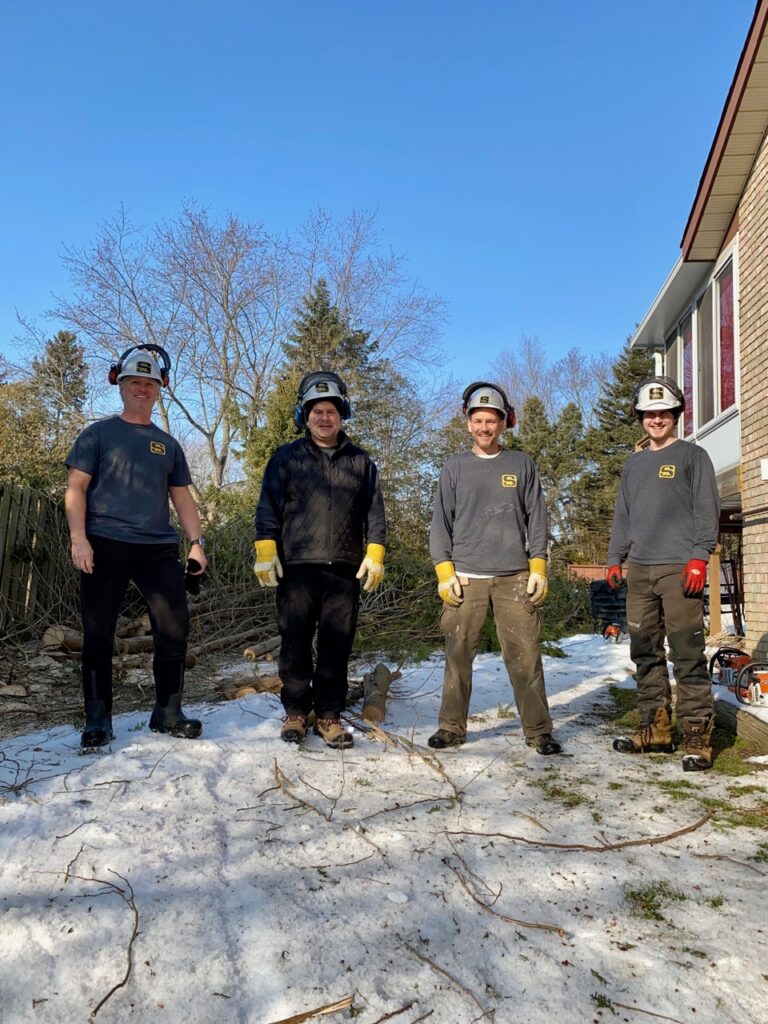
Meet the Stumps ‘R’ Us Team
Protect Your Property With Professional Tree Care
Now that you know what exploding trees in Ontario really are, you can respond with confidence instead of alarm. Most frost cracks heal on their own, but any cracked tree near a building, driveway, or walkway deserves a professional look. Catching problems early keeps small splits from becoming big hazards.

Stumps ‘R’ Us has served St. Thomas and Middlesex County for years with tree assessments, trimming, removal, and stump grinding. Our arborist knows Ontario trees and Ontario winters, and every recommendation is based on your property’s actual needs. The next time you hear that sharp crack and wonder about exploding trees in your yard, call or text Stumps ‘R’ Us at 519-854-8991 for a free estimate.