
Backyard tree removal turns technical the moment a crew cannot back a truck up to the trunk. Picture a 60 foot maple behind a fenced yard, boxed in by a garage and a shed. Nobody can drop that tree in one piece. Crews from Stumps ‘R’ Us take it apart from the top down instead, lowering each section on ropes until only a tree stump is left. This guide covers how the work is done, what the rules require, and what homeowners in St. Thomas, London, and Middlesex County should ask before hiring.
Why Tight Access Changes the Entire Job
Open ground tree felling is simple. The arborist cuts a notch on the side facing the fall, then makes a back cut from the opposite side. Between them he leaves a strip of uncut wood called a hinge. That hinge steers the trunk and slows the fall.
A backyard takes that option away, because a hinge only helps when the tree has somewhere safe to land. Fences, sheds, power lines, pools, garden beds, and a neighbour’s siding all sit inside the drop radius. Most residential gates measure 36 to 48 inches wide, so bucket trucks, chippers, and other heavy equipment cannot even reach the tree.
Crews working in confined spaces cut the tree into pieces small enough to handle. Every limb is cut, caught, and lowered on a rope rather than dropped. The work takes longer than a straight fell, and it needs a certified climber, rigging hardware, and a well drilled ground crew.
Signs a Backyard Tree Should Come Down
Not every crowded tree has to go, since pruning fixes plenty of clearance problems. Removal becomes the right call when one or more of these conditions show up:
- Branches touch siding, gutters, roofing, or power lines
- Large dead limbs run through the upper canopy
- The trunk shows decay, hollow sections, or a fungal shelf
- The tree leans toward a structure after wind or heavy snow
- Roots have lifted a driveway, patio, or foundation edge
- Insect or disease damage has spread past treatment
Hazardous trees behind a house carry more risk than the same tree in an open yard, because nothing stands between them and the buildings you own. A tree health check tells you which one you have.
How Arborists Remove Trees in Tight Spaces
Four methods cover nearly every job in confined spaces, and crews often combine two or three on one tree.
Top Down Sectioning
A climber goes up the trunk on a rope and works back down in stages. Small branches come off first, then larger limbs, then the trunk in short blocks sized for the ground crew to carry through the gate. This method needs no vehicle access, which makes it the first choice for enclosed yards.
Rigging and Redirection
Ropes run through an anchor point high in the tree, or through a tree next door, so the ground crew can steer a falling limb instead of watching it drop. A rigging block and friction device let one person lower several hundred pounds of wood.
Mechanical Advantage Systems
Portable winches and rigging control systems raise and lower wood at a set speed. They prevent shock loading, the sudden jolt when a heavy piece falls and catches, which snaps ropes and damages whatever sits below.
Crane Assisted and Compact Equipment
Some backyards can be reached from the street by boom. A crane lifts each section over the roof and the power lines to a drop zone on the driveway. Stumps ‘R’ Us runs boom truck and crane tree services for these sites. When a boom cannot reach, mini skid steers and ground mats move the wood out. Branches go through a chipper and leave as mulch. Trunk wood is loaded onto a log truck for disposal.
Protecting the Yard You Are Keeping
Safety planning covers your property, not just the crew. Before the first cut, expect the team to walk the site with you:
- Clear patio furniture, planters, and vehicles from the drop zone
- Lay plywood or ground mats over lawn and soft soil
- Pad fence tops and shed roofs along the lowering path
- Set a rope path that keeps wood away from garden beds
- Confirm access permission if the route crosses a neighbour’s yard
Raise these points during the estimate, since neighbour access needs lead time.
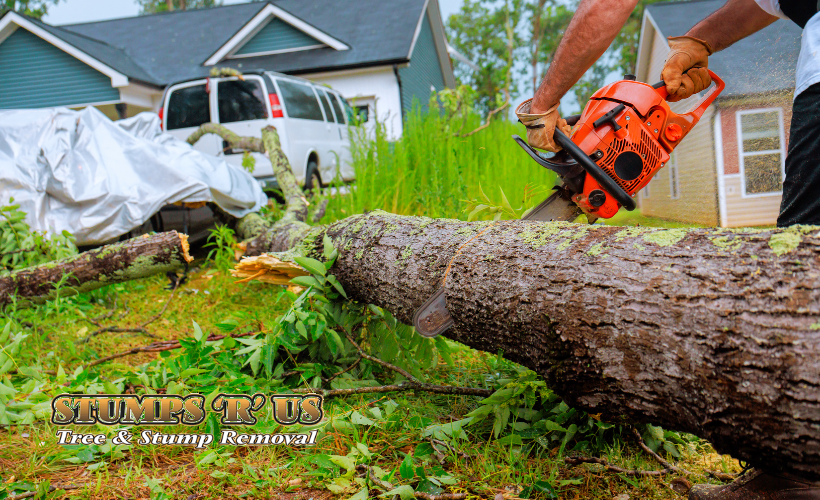
Homeowners underestimate weight. A green oak limb 10 feet long and 8 inches thick weighs more than 200 pounds, and it picks up speed the instant it leaves the tree. Safety gear lowers the odds of injury, but it does nothing about the hazards overhead, and a narrow yard leaves no room to step clear. If you carry no insurance, damage to a neighbour’s property becomes your bill. We list the other risks in 5 reasons not to cut down a tree by yourself.
Tree Removal Regulations, Permits, and Fines
Every Ontario municipality writes its own rules, and they change at the property line. A permit is usually required for protected tree species, trunks over a set diameter, and boundary trees shared with a neighbour. Cut a protected tree without one and the fines rise with the size and replacement value of the tree.
Arborist Reports and Hazard Assessments
Most permit applications need supporting paperwork. Arborist reports describe the tree, its condition, and the reason for removal. Hazard assessments go further and rate how likely the tree is to fail and what it would hit. Municipalities use arborist reports to judge whether a healthy tree can be removed, and hazard assessments to approve dangerous trees faster. Order arborist reports early, because review takes weeks and no crew starts without approval.
Trees on City Property
The tree at the edge of your lawn may not be yours. Boulevard and street trees on city property belong to the municipal urban forest. Cut a tree on city property without written approval and you face fines, even when the branches hang over your roof. Confirm who owns the tree before you book, and ask whether the municipality prunes trees on city property itself, since that work may cost you nothing.
Emergency Exemptions
Storm work is treated differently. Most bylaws allow immediate removal once a tree has failed or presents imminent hazards to people or buildings. Photograph the tree before the crew starts and keep the invoice, because thin paperwork turns a legitimate storm removal into fines months later. Debris disposal still follows the normal rules.
What Drives the Price
Tight access raises the cost for predictable reasons. Pricing depends on:
- Tree height, trunk diameter, and wood density
- Distance between the tree and the nearest structure
- Whether a crane can reach the site from the street
- Crew size and total hours on site
- Debris volume and haul out distance
- Stump grinding, if you want the stump gone as well
A tight backyard removal costs more than the same tree in an open front yard, since it takes more hours and hands. Permit fees add a line to the bill, but always cost less than the fines for skipping them. Our guide to tree removal rates and estimates breaks the numbers down, and every estimate from Stumps ‘R’ Us is free.
Finishing the Job With Stump Grinding
Cutting a tree to ground level leaves a stump that sends up new shoots, attracts carpenter ants, and blocks new landscaping. Grinding takes it out below grade, so you can lay sod, plant, or build over the spot. Compact grinders fit through a standard gate, so the access problems that complicated the removal rarely slow the grinding. See how our stump grinding service works.
Talk to the Crew That Fits Through the Gate
Every tight yard is different, and the only way to price one is to look at it. Joe and the team at Stumps ‘R’ Us have taken down trees behind narrow lots, over pools, beside garages, and between hydro lines across St. Thomas, London, Elgin County, and Middlesex County. We are fully insured, we work to municipal safety standards, we grind the stump once the tree is down, and we clean up before we leave.
Call or text 519-854-8991, or request a free estimate online, and let Stumps ‘R’ Us handle your backyard tree removal safely the first time.