
Tree Fungus shows up on Ontario properties far more often than most homeowners expect. A hard shelf pushes out of a maple trunk. Honey coloured mushrooms rise at the base of an oak in October. Some of these growths are harmless. Others are the only visible sign of tree decay that started inside the tree years ago. Knowing which is which protects your property, your family, and your wallet.
The crew at Stumps ‘R’ Us inspects trees across St. Thomas, London, Elgin County, and Middlesex County. We see the same tree fungi season after season. This guide shows what each one looks like, which trees it picks, and what it means for your tree.
Three Groups of Fungi That Live on Trees
Every fungus on a tree fits into one of three groups, and the group tells you how worried to be.
- Symbiotic (mycorrhizal) fungi live on tree roots and trade water and minerals for sugar from the tree. Both sides gain.
- Saprophytic fungi eat dead wood. King Alfred’s Cakes and many bracket fungi appear only after drought, injury, or disease has already killed part of the tree.
- Parasitic fungi attack living tissue. They pick off trees that are already stressed, and they often finish the job.
How Decay Fungi Damage Wood
Decay fungi are sorted by the part of the wood they eat, and each leaves a different result:
- White rot breaks down both lignin and cellulose. The wood turns pale, soft, and spongy.
- Brown rot eats the cellulose and leaves a dry brown residue. The wood crumbles into cubes and snaps under load.
- Soft rot works slowly through wet surface wood. Soft rot survives where white and brown rot cannot, so soft rot shows up in soggy root collars and old pruning cuts.
Heart rots deserve the most attention. These fungi hollow out the heartwood, the dead core that gives a trunk its strength, while the living outer ring keeps feeding the canopy. A tree with advanced heart rots can carry a full crown of green leaves and still stand close to failure. Heart rots spread outward slowly, often over decades. The pathogen usually enters through cracks, broken limbs, and old pruning cuts. Vertical cracks in the bark and a hollow sound when you knock on the trunk are the first clues that heart rots are at work. Our guide to tree rot explains how the process moves.
Common Conks and Shelf Fungi on Ontario Trees
A conk is the hard, shelf shaped fruiting body of a decay fungus. Think of it as the mushroom of a fungus that lives inside wood. Most are polypores, which drop spores through tiny pores underneath instead of gills. By the time a conk appears, the fungus has fed inside the trunk for years, and the rotted area is far bigger than the shelf you see.
Artist’s Conk (Ganoderma applanatum)
Artist’s Conk grows as a hard, flat bracket with a brown top and a chalk white underside. Scratch the underside and the mark turns dark, which is how it got its name. It decays sapwood and heartwood in roots and trunks of broadleaf trees and conifers. Maple, beech, poplar, and ash are common hosts in southwestern Ontario. One Artist’s Conk at the base of a mature shade tree usually means the root collar has lost its strength.
Turkey Tail (Trametes versicolor)
Turkey Tail grows in thin, flexible fans banded in brown, tan, grey, and blue. The rings look like the spread tail of a wild turkey. It feeds on dead wood only. On a fallen log or old stump, it is normal recycling. On a standing trunk, it tells you that section of wood has already died.
Chicken of the Woods (Laetiporus sulphureus)
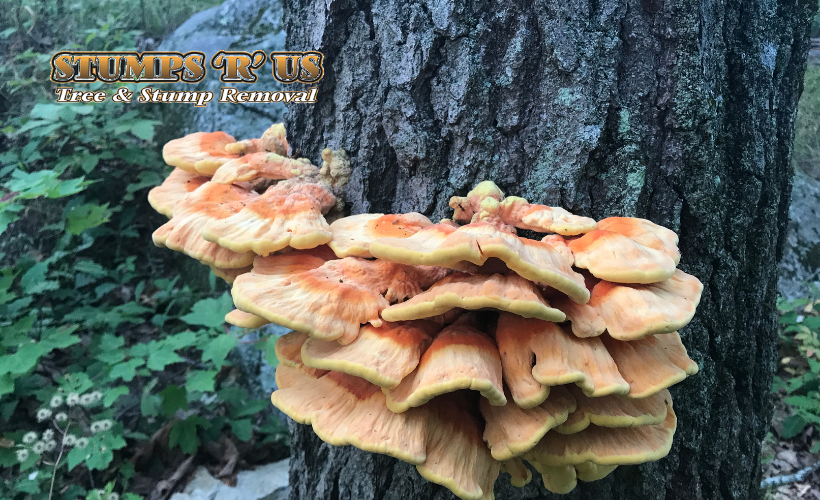
Bright orange and yellow shelves appear on oak, cherry, and willow in late summer. This fungus causes a brown rot in the trunk and lower limbs. A tree carrying it has already lost sound wood at its core.
Birch Polypore (Piptoporus betulinus)
Birch Polypore grows only on birch trees. Look for round, pale, hoof shaped brackets on a trunk that is already thinning. The brown rot inside leaves the wood brittle, and brittle wood snaps in wind. Hosts are usually weakened first by drought or bronze birch borer.
Common Tree Mushrooms on Trunks and Roots
Honey Fungus (Armillaria spp.)
Honey Fungus causes Armillaria root rot, the most destructive fungal problem on Ontario properties. Look for yellowish brown mushroom clusters at the base of a tree in autumn. Below ground, the fungus turns root and collar wood into a white stringy pulp. It travels from tree to tree through black, root like strands called rhizomorphs, so an infection in one corner of a yard can reach healthy trees metres away.
Oyster Mushroom (Pleurotus ostreatus)
Oyster Mushroom grows in overlapping clusters of creamy white to grey caps on stressed or dead broadleaf trees. Maple, poplar, and beech are the usual hosts. This white rot fungus leaves the wood pale and spongy. A large flush on a trunk points to a big column of dead wood behind the bark.
Harmless Growths People Mistake for Decay
Not every growth near a tree is bad news. Lichens form flat grey green crusts on bark. These lichens feed on light and air and use bark only as a perch, so they cause no harm. Surface mold after a wet week is cosmetic and washes off. Puffballs are another common sight in Ontario yards. Puffballs in lawn soil feed on buried roots and old organic matter, not on your standing tree.
Helpful Fungi: The Mycorrhizal Partners
Some fungi help. Fly Agaric (Amanita muscaria), the red mushroom with white flecks, wraps its threads around tree roots and trades minerals and water for sugar. A bolete builds the same partnership with oak, pine, and birch. These root partnerships feed forest ecosystems across the province. The simple rule: mushrooms rising from open soil are usually partners, while growths pushing out of bark, trunks, or root flares are eating the tree.
Diseases That Follow Fungal Infection
Fungal diseases start when a spore lands, germinates, and sends threads into living tissue. Root and butt rot kills roots and the lower trunk with almost no warning above ground. Canker diseases enter through pruning wounds and storm damage, then kill patches of bark. Foliar and shoot diseases blotch leaves and needles and cut the food a tree can make. Vascular wilts plug the plumbing that carries water to the canopy. Dutch elm disease is the best known Canadian example, and it stripped mature elm trees from streets across southern Ontario. Our guide to common tree disorders walks through the diagnosis.
Warning Signs That Call for an Arborist
A fruiting body matters most when it appears with other symptoms. Book an inspection if you notice any of the following:
- Conks, polypores, or mushrooms on the trunk, root flare, or exposed roots
- Soft, crumbling, or hollow sounding wood at the base of the tree
- Thinning canopy, undersized leaves, or dieback in the upper branches
- Mushroom clusters that return to the same spot every autumn
- White fungal sheets or black root like strands under loose bark
- A leaning trunk, split soil, or lifted turf on one side of the root plate
These signs point to lost structure, and they often show up with the early signs of a dying tree. A tree with decayed roots can fail in a summer thunderstorm, which is why dangerous tree removal belongs to trained crews with proper rigging.
How to Protect Your Trees from Fungal Decay
Decay cannot be undone once it is inside the wood, so prevention does the real work. Water trees through dry summers. Mulch the root zone, but keep the mulch off the trunk. Keep mowers, trimmers, and equipment away from bark, because every wound is a doorway. Prune properly and at the right time of year so cuts seal fast. Fungicides help with some leaf and shoot problems, but they only work before infection starts and cannot cure a hollow trunk. Remove dead and dying trees before decay spreads through shared roots. Grind out infected stumps instead of leaving them as food for Honey Fungus. Our stump grinding service removes that rotting wood for good.
Get Your Trees Inspected by Stumps ‘R’ Us
Tree Fungus on a mature tree is a question of structure, not looks. A conk on a trunk or a ring of mushrooms at a root flare tells a trained arborist how much sound wood is left and how much risk the tree carries. Stumps ‘R’ Us gives you free estimates, full insurance, and a straight answer across St. Thomas, London, Elgin County, and Middlesex County.
Call or text 519-854-8991 to book an inspection, or read more tree health guides on our blog. You can also get in touch online, and a certified professional from Stumps ‘R’ Us will look at your trees and explain your options.